|
How well do you know your guns? |
|||
| ...
August 3 - August 23 |
|||
|
|||
|
|||
|
|||
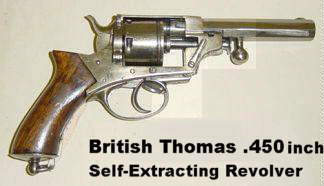
| Patented
in 1869, this was the first English revolver to make any attempt at simultaneous
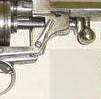
extraction and self-ejection. It is so designed that by pressing a catch
located forward of the trigger guard and giving a half turn to a bolt fixed
on the underside of the barrel, the cylinder was drawn forward by
a powerful camming action designed to loosen the spent cases in the chambers.
This also released the barrel from the frame of the pistol, so that
it could be thrust forward to the full extent of its travel, thus ejecting
all empty cases from the cylinder.
Although clumsy in its action, this did allow the user to extract the five cartridges with a single motion, requiring no more effort than was necessary to eject a single spent case from the cylinder of an Adams or Tranter pistol of the same period. Before reloading, it was necessary to return the barrel and cylinder to their original position, so that fresh cartridges could be loaded through the loading gate on the right hand side of the breech. |